

Get quote
Get Free Consultation!
We are ready to answer right now! free consultation.
A loading arm manufacturer cannot build a reliable specification from a product name alone. The arm has to fit a medium, a vehicle or vessel connection, a pipe route, a working height, a movement envelope and an operator’s routine. If the buyer says only “top loading arm” or “marine loading arm”, the manufacturer still needs to know whether the project is for petroleum, chemical liquid, LPG, liquid ammonia, liquid chlorine, LNG, ethylene or another medium. The manufacturer also needs to know whether the connection is top hatch, bottom coupler, ship manifold, vapor return or a sealed transfer route.
Yuanda’s product catalog gives a practical base for specification work because it separates land loading arms, gas and chemical arms, cryogenic arms, aluminum arms and marine loading arms. It also lists real model names such as AL1512, AL1401, AL1402, AL1403, AL1412, AL2404, AL2503, AL2543, AM62, AM64, AM63M, AM62H, AM63H, AM64H and AM63HE. This article explains what a buyer should prepare before asking a manufacturer to finalize an arm selection.
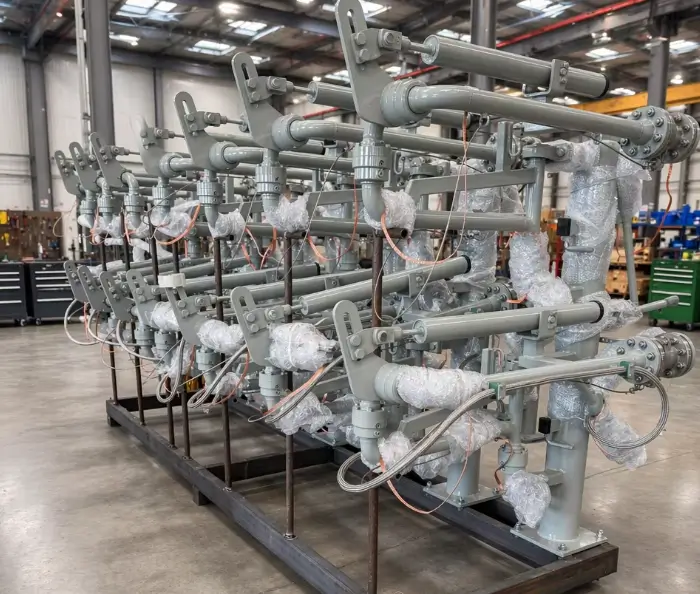
Medium controls much of the technical discussion. Ambient petroleum service, heated chemical service, liquefied gas service and cryogenic service do not create the same sealing, material or safety questions. Connection controls the next group of decisions. Top loading can involve hatch position, operator access and vapor control. Bottom loading can involve coupler geometry, adapter position and parking. Marine loading can involve manifold height, ship movement and emergency disconnection planning. Movement controls whether the arm can reach each working position without forcing the operator to fight the equipment.
A buyer who gives these three groups of information early will get a better specification than a buyer who asks for the cheapest arm first. The manufacturer’s drawing and product recommendation can then be checked against real site limits. If the arm must reach several tanker compartments, the manufacturer can review reach and balance. If the arm must work near a platform, the manufacturer can coordinate folding stairs and trestle layout. If the arm must connect to a ship manifold, the manufacturer can review whether manual or electro-hydraulic operation is appropriate.
Yuanda’s top loading arm range includes AL1512, AL1401, AL1402, AL1403, AL1412 sealed top loading arm and AL1513. These products are not selected only by pipe size. The buyer should provide tanker height, manhole position, compartment count, platform height, whether vapor return is needed and whether the operator works from a fixed platform. If folding stair or platform trestle equipment is part of the bay, it should be discussed with the arm, because operator access changes how the arm is parked and used.
Yuanda lists AL2404 bottom loading arm, AL2503 bottom loading arm and AL2543 bottom loading and unloading arm. Bottom loading can make the working area cleaner and reduce work at height, but the buyer should confirm the tanker adapter, connection height, hose or rigid arm route, parking space and any vapor recovery expectation. If the project uses a bottom loading skid or automatic quantitative loading system, the arm and skid layout should be reviewed together rather than split into separate late-stage purchases.
Not every buyer needs a special arm, but some applications clearly do. Heat-traced loading arms may be needed when the medium must stay within an operating temperature range. PTFE-lined or otherwise protected routes may be discussed when chemical compatibility is part of the risk. Cryogenic loading arms belong in LNG or ethylene service where low temperature and thermal movement are major concerns. Fully pneumatic automatic loading arms may be considered when operation needs higher automation and reduced manual effort. The manufacturer should explain why the special route is needed, not simply list it as an upgrade.
| Arm route | What the buyer should confirm | Yuanda model examples |
|---|---|---|
| Top loading | Tanker height, manhole position, vapor return and access platform | AL1512, AL1401, AL1402, AL1403, AL1412 |
| Bottom loading | Adapter position, coupler route, parking and control skid interface | AL2404, AL2503, AL2543 |
| Cryogenic loading | Medium temperature, insulation route, emergency and pipe stress concerns | Cryogenic Loading Arm for LNG Unloading |
| Marine loading | Ship manifold, movement, manual or hydraulic operation and emergency release | AM62, AM63H, AM63HE |
Marine arms such as AM62, AM64, AM63M, AM62H, AM63H, AM64H and AM63HE work across a dock-to-ship interface. The buyer should confirm manifold envelope, tidal or draft variation, operation mode, support structure, emergency release expectation and whether marine gangway, hose crane or quick release mooring hook is part of the same terminal package. A manual arm may fit one terminal, while electro-hydraulic control and emergency release may be more suitable when the transfer operation is heavier or more safety-sensitive.
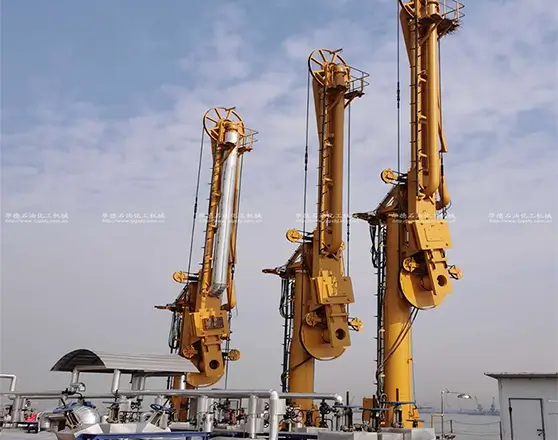
A buyer should ask for inspection checks that match the arm. For a top loading arm, the buyer may care about rotation, balance, sealing surfaces, end connection and surface protection. For a bottom loading arm, coupler interface and parking arrangement become more important. For a marine loading arm, support structure, hydraulic operation, emergency release arrangement and maintenance access may require more attention. For cryogenic service, the buyer should be careful about thermal movement, material suitability and the way the arm is protected during shipment and installation.
Shipment preparation matters because many arms are not small parcels. The buyer should ask how the arm will be protected, whether sections are packed separately, what installation drawings or assembly references will be included and how accessories are identified. A project contractor receiving several arms for different lanes should request clear marking by bay, model and connection route. This reduces the chance that a field team installs the wrong arm or accessory in the wrong loading position.
The manufacturer should also help the buyer decide which spare or wearing parts belong with the first order. A remote terminal may not want to wait for small replacement items after the equipment is installed. For loading arms, the buyer may discuss sealing rings, swivel-related service items, connection caps or breakaway-related parts depending on the application. The point is not to buy a large spare stock blindly, but to identify small items that would stop the loading bay if they were not available when needed.
Yuanda’s loading arm accessories include safety cantilever, loading arm breakaway valve, sealing cap, sealing ring, dry disconnect valve, aluminum alloy drain pan, loading arm swivel joint and hose-type breakaway valve. These accessories should not be added casually after the main arm is approved. A breakaway valve may be part of a safety plan. A dry disconnect valve may matter when spillage control at connection or disconnection is important. A swivel joint is central to movement and sealing behavior. The accessory list should be tied to the medium and operating scene.
A buyer approving accessories should ask where each accessory sits in the operation. Does it protect the arm during vehicle movement. Does it reduce product loss when disconnecting. Does it protect the connection when the arm is parked. Does it help the operator drain residual product safely. These questions make the accessory list useful instead of decorative. They also help the manufacturer avoid suggesting a part that is technically interesting but not needed for the buyer’s actual loading route.
A drawing that only shows the arm shape is not enough for a serious approval. The buyer should be able to see where the arm parks, how it reaches the tanker or ship connection, where the operator stands and what space must stay clear. For a road tanker bay, this helps avoid conflict with handrails, folding stairs or adjacent lanes. For a marine arm, it helps the buyer understand the relationship between support structure, manifold position and the safe working envelope. When a manufacturer marks those points clearly, site review becomes much easier.
For a full system order, the drawing should also connect the arm to nearby equipment such as platform trestles, loading skids or marine terminal equipment. This does not mean one drawing must solve every field detail, but it should show enough interface logic for the buyer’s civil, piping and operation teams to review the same assumptions.
A clean specification also states the buyer’s responsibilities. The manufacturer may supply the arm and related accessories, but the site may still need suitable support steel, flange preparation, bolts, gaskets, lifting equipment, platform access, electrical wiring or local installation labor. If these items are not written down, the buyer may assume they are included and the supplier may assume they are outside scope. That gap creates frustration at the exact moment the field team is trying to install the equipment.
For road tanker loading, the buyer should check vehicle position, lane width and platform clearance before the arm arrives. For marine loading, the buyer should check dock structure, manifold envelope and safe parking area. For cryogenic service, the buyer should check whether local teams understand the additional care required around low-temperature equipment. These site preparations are not a substitute for manufacturer quality, but they decide whether the finished arm can be installed without delay.
If the arm is part of a larger Yuanda equipment scope, the buyer should make the same responsibility split for batch loading control systems, folding stairs, platforms and accessories. A loading arm manufacturer that helps document these boundaries gives the buyer a more reliable project record than one that treats the sale as a loose component shipment.
The same habit helps after commissioning. When the site team later asks for a replacement seal, swivel service item, coupler part or added access component, the original responsibility record shows which equipment family and operating condition the part belongs to. That shortens future communication and helps the buyer avoid ordering a part that looks similar but belongs to another loading route.
For buyers who operate several depots, that record can become a practical spare-parts map. It separates road tanker arms from railcar loading arms, cryogenic transfer arms from ambient chemical arms, and marine arm accessories from land-side accessories before maintenance teams start comparing photos or old purchase orders.
Before order approval, the buyer should have a file that includes the medium, temperature, pressure, flow rate, loading route, connection type, model family, material or lining expectation, operation mode, accessories, access equipment and available drawings. If the loading point is part of a larger system, add skid control requirements and tank equipment notes. Use Yuanda’s land loading arm range, marine loading arm range and loading arm accessories to build that file before sending the final purchase request.
A manufacturer can give better technical support when the buyer avoids vague language. Instead of asking for “one loading arm for chemical liquid”, state whether the site needs top loading, bottom loading, sealed transfer, heat tracing, pneumatic operation, marine operation or cryogenic service. Instead of asking only for a price, ask what information is still missing for final approval. That habit makes the manufacturer comparison more useful and helps the project team choose equipment that fits the actual loading point rather than a generic catalog line.
