

Get quote
Get Free Consultation!
We are ready to answer right now! free consultation.

A buyer looking for a truck loading arm supplier usually needs equipment that works with a real loading rack, not an isolated catalog item. The first checks are tanker geometry, top or bottom connection, medium behavior, operator access and whether the rack needs metering or batch control. Yuanda Machinery’s published range includes truck and rail land loading arms, bottom loading arms, top loading arms, folding stairs, platform trestles, loading arm accessories and skid-mounted control systems, so the buyer can compare the full loading lane before approving the order.
Truck loading has a familiar rhythm, but small differences can create large problems. Tanker height, manhole position, adapter height, compartment layout and driver stopping accuracy all affect how the arm feels during every shift. A supplier that only asks for pipe size may miss the daily work. A better supplier asks for lane drawings, tanker details, medium data, flow expectation, access arrangement and whether the buyer wants a simple arm or a controlled loading island.

Top loading and bottom loading create different equipment and safety discussions. Top loading depends on access to the tanker top, drop pipe route, manhole location and vapor or splash control. Bottom loading depends on adapter location, coupler movement, sealed connection and lane spacing. The buyer should not let a supplier quote both routes as if they were only different orientations of the same product. They solve different problems and should be approved from different site information.
Yuanda’s land loading arm range includes AL1512 top loading and unloading arm, AL1412 sealed top loading arm, AL1513 top loading arm, AL2404 bottom loading arm, AL2503 bottom loading arm and AL2543 bottom loading and unloading arm. A truck loading arm supplier should explain why one of these families fits the rack and why another may not. The explanation is often more valuable than the first price because it shows whether the supplier understands the operating route.
When a truck loading rack uses top loading, the buyer should review the arm with folding stairs and platform trestles. The arm may reach the manhole, but the operator still needs safe access and enough room to move. The supplier should check whether the stair lands correctly, whether the arm parks away from the walkway, and whether the operator can control the drop pipe without leaning into an awkward position. These details affect the loading shift more than a specification table suggests.
Bottom loading is often selected for sealed transfer and lower work-at-height exposure, but it still needs precise connection review. The supplier should ask where the adapter sits, how far the arm must travel, whether multiple arms work in the same bay, and how the coupler is parked after loading. General industry references often discuss bottom loading and vapor recovery arrangements, but the supplier still has to turn that general practice into a drawing that matches the buyer’s vehicle fleet.
Truck loading arms for petroleum, chemicals, LPG, liquid ammonia, liquid chlorine or cryogenic products should not be treated as one universal item. The medium affects sealing, material route, lining, heating, gas return, drainage and maintenance expectations. The buyer should send the supplier a clear medium list and identify whether products share a lane or require separate loading routes. If several media are handled in the same terminal, the supplier should help the buyer avoid unsafe assumptions between similar-looking arms.
The operating cycle matters too. A high-frequency depot may care about quick connection, clear parking and spare part planning. A lower-frequency chemical loading point may care more about material compatibility and clean disconnection. A distributor supplying arms to different end users should ask the supplier to label which models belong to routine petroleum service and which require project-specific confirmation before resale.
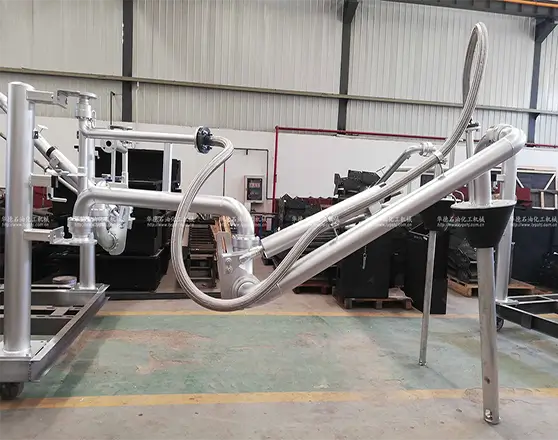
Open top loading may be suitable for some applications, but vapor-sensitive or hazardous products can require sealed handling. The buyer should ask the supplier whether a sealed top loading route is needed, whether vapor return is part of the system, and whether the arm needs accessories to keep the parked position clean. A sealed top route is not simply a more expensive version of open fill; it changes the way the operator connects, loads and disconnects.
| Truck rack question | Supplier should confirm | Why it matters |
|---|---|---|
| Does the tanker load from top or bottom? | Arm family, connection route, access and parking position. | Prevents choosing the wrong geometry. |
| Is the product open-fill, sealed, heated or hazardous? | Drop pipe, sealing, vapor return, lining or heating route. | Keeps medium behavior inside the equipment decision. |
| Does the rack need delivery records? | Batch controller, metering skid or management interface. | Avoids adding control after the mechanical layout is fixed. |
| How will the shipment be installed? | Crate marking, loose parts, lane labels and buyer-prepared work. | Reduces field confusion after delivery. |
A truck loading rack order may include arms, loading arm accessories, folding stairs, platform sections, skid-mounted systems and documents. The supplier should mark each item by lane, service and arm family. This matters when the rack has several bays or several media. If the site team receives unmarked accessories and several similar arms, installation becomes slower and later maintenance records become weaker.
A contractor should ask for a shipping and installation file that names assembled items, loose accessories and site-prepared work. Some arms or skid components may ship partly separated for protection. That is acceptable when the file is clear. It becomes a problem only when the site team expects a complete plug-in assembly and receives several crates without enough context to match the parts to the drawing.
If the rack includes a skid-mounted loading system, the supplier should discuss more than mechanical arm reach. Yuanda’s batch loading control systems include top loading skids, bottom loading skids, card-based systems, host computer management systems, batch controllers and automatic quantitative loading systems. The buyer should ask how the arm, valve sequence, metering route and operator workflow fit together before treating the skid as a separate purchase.
A truck rack with control requirements should also identify what the operator sees during a normal loading cycle. Does the operator select a preset amount, scan or enter a loading instruction, connect grounding or interlock devices, then open the arm route? Does the system need management data after loading? These workflow questions decide whether the supplier should quote a simple mechanical arm or a more coordinated loading station.
A supplier should describe the difference between factory-assembled skid components and site-installed arm or access equipment. The buyer may receive a skid frame with instruments already mounted, while arms, folding stairs or accessories arrive separately for installation. That is workable only when the packing marks and drawings show how every item belongs to the same truck rack layout.
Internal planning can begin with the fluid transfer equipment supplier package guide and the loading arm manufacturer specification guide. For product selection, compare Yuanda’s land loading arm families with skid-mounted systems and safe access equipment. These pages help the buyer decide whether the truck rack is a simple replacement or a larger loading station package.
A truck loading rack should be easy to operate after the novelty of new equipment has passed. The supplier should help the buyer identify routine inspection points, spare part families, seal and swivel service routes, and accessory ownership. If a site has several bays, these details should be recorded by lane. If a distributor supports several end users, the same record should travel with the order so future replacement discussions do not depend on memory or product photos.
The first operating season is where vague supply files show their weakness. Operators may ask why one arm is harder to connect, why a coupler part is different from the next lane, or why a drain pan was not included where product drips during disconnection. If those questions were discussed before purchase, the site can solve them through training or normal service. If they were ignored, the buyer may blame the equipment even when the original problem was an incomplete scope.
For replacement orders, the supplier should ask whether the buyer wants to copy the old rack or improve it. Copying may be fastest when the old system worked well and the site wants minimal change. Improvement may be better when the old rack had poor access, frequent leakage, awkward parking or missing batch records. The supplier’s role is to help the buyer make that choice deliberately instead of repeating old weaknesses because they are familiar.
Truck loading buyers should also check how the supplier handles operating differences between petroleum, chemical and gas-related routes. A simple fuel loading lane may mainly need clean movement and reliable sealing. A chemical lane may need more careful material and drainage discussion. A gas or cryogenic route should move into a more specialized product family instead of being treated as an ordinary truck arm.
A distributor selling truck loading arms should keep these distinctions visible in its own sales file. The end user may ask for a replacement by photo or by old supplier name, but the distributor should still confirm loading route, medium, connection height and accessory needs. A supplier that helps the distributor ask those questions reduces wrong orders and improves repeat business.
For contractors, the final supplier file should travel to the site supervisor, not only to the purchasing office. The supervisor needs to know which crate belongs to which bay, which accessories are loose, which bolts or gaskets are prepared locally and which sequence should be followed when installing the arm with access equipment or skid components.
Before approving a truck loading arm order, the buyer should have a final file that includes tanker geometry, loading route, medium, arm family, access equipment, accessory list, skid or control requirement, packing marks and site responsibilities. If the supplier can help create that file, the project has moved beyond a simple price comparison and into a loading rack decision that operators can actually use.
The buyer should keep that file with the rack after installation. When operators report a connection issue, or when maintenance asks for a seal, swivel or coupler part, the site can refer back to the original arm family and service condition. That makes the supplier relationship more efficient and protects the rack from casual replacement choices.
The same file is useful when the terminal adds another truck lane. The buyer can decide which old decisions can be repeated and which should be reviewed again because the vehicle position, product, access route or control requirement has changed.
A supplier that supports this kind of record keeping is easier to work with after the sale because every later question starts from the actual rack, not from a vague product description. It also makes the next truck loading rack order faster to evaluate and easier for the team to approve.
It also keeps future spare part discussions tied to the correct truck lane.
